Showing posts with label Virtue. Show all posts

Monday, July 16, 2018

How to Deal With Offense and Contention

It has been my experience that when people get offended it is due to a misunderstanding or miscommunication.  Also, when we face strife and contention pride is a major component.  If we can learn to exercise patience and humility, if we strive to harbor understanding, then we can leave behind much of the pain, suffering, and sorrow of our day-to-day lives.

This post will focus on offense, but the principles are universal and can help us with contention as well.
I've given quite some thought to this.  More than that, I've tried to apply certain principles to my own life.  Mainly I ask myself some questions at times when I could be possibly offended.  Usually the result is that I come up with several harmless alternatives for the reasons behind the offense.  I can forgive the possible fault and move on.  Often in the course of this I experience a moment of wry humor in the recognition of what I like to call the "human condition."  Basically, we are all human and thus we are all prone to mistakes.

We've all said or done something that we've regretted. Or we said or did it in a way that didn't convey our intentions as well as we would have liked.  What one person may consider an unpardonable slip in speech or action may be a weakness of another.  Also simple differences in our nurture and our environment instill in us differences of opinion and expression.  Misunderstanding comes quickly when we assume that we  know the thoughts behind a person's words or deeds and that our judgement is perfect.  Simply remembering that there may be more behind an action--things that we do not or cannot see, or a simple mistake--should be enough to help us pause.

When we pause in our judgements, let us use a few simple mechanisms to evaluate the perceived offense.  These mechanisms, expressed in writing, take the form of a list of questions.  However, by force of time and habit they become more a part of our character than an external checklist.
  • First, could I see myself making the same statements or doing the same thing under any conceivable set of situations, even those beyond what I have experienced myself?
  • Now, what are some other possible explanations for the offending act or word?
  • Is this simply a case where the person could not find a better way to express themselves?  Or did they perhaps forget the expression that they wanted and had to make due with a less-effective substitute?
  • Has the potential offender ever been in this situation before?  Could that affect how they might act?  Could that affect the possibility of being misunderstood and giving offense?
  • Did I expect the person to be offensive in that way? And do I really, honestly think that they were intending to be offensive?
  • Have I ever been misunderstood?
  • Have I ever inadvertently given offense?
  • And, not least of all, does it really matter?
  • Is it worth getting offended over?
  • Is it worth a reaction on my part?
  • Would it be beneficial take up a defense, to criticize, or to correct in response?
  • Is there another, more appropriate response that I could give, rather than to become offended?
  • Basically, what is the truth behind the statement or action?  Was the truth spoken?  Am I the one at fault for being out of line with the truth?
Premeditation on how to avoid or prevent offense and on how to promote understanding is also worthwhile.  How can I make sure that I don't get offended? (Whether or not offense was meant to be taken.)  What can I do when I do feel offended?  Why do I usually get offended?  What are some causes of offense in general?

My answer to that last question is where I started this blog.  Misunderstanding and pride.  The same approach applies perfectly to resolving both misunderstanding and pride:  What led to the conflict?  Was it meant that way?  Is it worth it?  Am I in opposition to the truth?

There is a principle of humility and meekness in the ongoing effort to evaluate and understand offenses and contention.  This is especially true when we are willing to ask "Am I at fault?" and to confess, if only to ourselves, our own guilt.  Since humility and meekness are opposite of pride and unbridled passion, then as we cultivate the former the latter will fade.

Of use may be an address given by Elder Joseph B. Wirthlin entitled "Come What May and Love It."  He applies a set of principles to enduring trials in life.  The same can be used in the context of what we have been discussing here.  Portions of the address were used to create the following video which highlights the main points.


Saturday, December 15, 2012

Same blog, new name

For those who may have noticed, or didn't as the case may be, I've changed the name of this blog. I figured that since completing my mission and returning home, things have changed slightly. I am no longer set apart as a full-time missionary with the special commission to "go... into all the world... and preach the gospel."  I am however still a member of the Church of Jesus Christ of Latter-day Saints and I will continue to let my light shine and "be an example" in everything I do and say.

Just as I am no longer called "Elder," my blog also has a different name reflecting my current position in life. I hope you'll stick around and share your comments as I share my thoughts on living the gospel and being an example in all things.

Tuesday, October 16, 2012

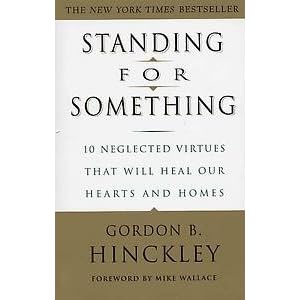
Standing For Something: 10 Virtues

In light of my return home and the things that I've learned (and hopefully become) on my mission, I want to start a series of posts based on President Gordon B. Hinckley's book "Standing For Something."  These posts will hopefully serve as a successful transition from my full-time missionary work to my personal life at home.

These posts will touch on faith, hope, charity and love, service, and becoming, among other virtues.  My hope is that these posts will bless you, the reader, and help you strive for and obtain the best within you.

The virtues that President Hinckley writes about are as follows:
  1. Love
  2. Honesty
  3. Mortality
  4. Civility
  5. Learning
  6. Forgiveness and Mercy
  7. Thrift and Industry
  8. Gratitude
  9. Optimism
  10. Faith
President Hinckley also discusses two gaurdians of virtue: Marriage and the Family.

It has been a little while since I have read the book, so I ask for your patience as I work on these posts.  As I finish each post I will add links to them from this post.

Tuesday, October 9, 2012

What I've Learned on My Mission

I want to start with a "Thank You!" to everyone in New York!  Thank you for two wonderful years in your service.  I hope our friendships can continue on and grow, even as we are miles apart.

So, what have I learned during these 24 months away from home?

Several things stand out as of prime importance.

First, we must develop faith, hope, and charity as Paul has taught.  If we have nothing to believe in, no hope for life after death, then our life becomes dark and we are inclined to cynicism.  Such an attitude does not lend itself to the Charity and love that should fill our souls.  "Believe in God; believe that he is... believe that he has all wisdom, and all power, both in heaven and in earth; believe that man doth not comprehend all the things which the Lord can comprehend." (Mosiah 4:9)  "Wherefore, ye must press forward with a steadfastness in Christ, having a perfect brightness of hope, and a love of God and of all men. Wherefore, if ye shall press forward, feasting upon the word of Christ, and endure to the end, behold, thus saith the Father: Ye shall have eternal life." (2 Nephi 31:20)

Second, selfless service is paramount in putting off the natural man, becoming like Christ, and becoming fully converted to His gospel.  Conversion comes as we honestly and consistently live the gospel of Jesus Christ.  The central doctrine of His gospel is His Atonement and selfless sacrifice for us.  This sacred service to us would not have been possible if Christ weren't who He was.  When the selfish natural man in each of us would have turned inward, Christ always turned outward.  For example, despite the pains, abandonment, sorrow, and persecutions of His suffering in the Garden and on the cross, Christ still spoke to the Father on behalf of the Roman soldiers who had treated Him so cruely: "Father, forgive them, for they know not what they do." (Luke 23:34)  If you or I were in such a situation we would be more likely to curse our enemies than to bless them; or at the least not spare a thought for them as we focused on our own recent troubles.
   So how do we change our nature and come to love our enemies and pray for those that despitefully use us? (see Matthew 5:44)  We turn outward as the Savior did and serve without thought of personal reward or gain.  As we lose ourselves for the gospel's sake and for Christ's sake, we will find ourselves. (see Matthew 16:24-25)  We will not find ourselves if we set out to accomplish it.  We will only find ourselves as we lose ourselves in others; and we won't be looking for it to happen.

Third, ultimately it is only the gospel that can solve all our problems and save us.  There are so many problems, so many heartaches and troubles in this world.  Society runs around looking for new and novel ideas to problems that humanity has been faced with since the fall of Adam and Eve.  There is no greater or more powerful answer to all our concerns than the very answer that was given to our First Parents.  Christ and His gospel remain the only way to fully solve every social, civil, and personal problem.  In the gospel we not only find the virtues that are the basis of a sound and happy life, but also the principles of righteous living that bring the blessings of God to us and our families, nations, and world.

Lastly, I know that God the Father is our loving Heavenly Father.  He knows us each individually and desires our happiness and salvation.
   I know Jesus Christ is His Son, our Savior.  His Atonement can cleanse and heal us from the deepest sins and wounds, if we are willing to change what we need to and live His gospel.
   I know the Spirit of the Lord can speak to each of us.  He has spoken to me from time to time.  We can know what we need to know and do.  We can be comforted and encouraged in our daily struggles.
   I know that the church and kingdom of God are on the earth again.  God has restored everything necessary for the salvation of all His children.  We have again among us living prophets and apostles who speak the mind and will of God.  There is consistency and safety in their words because they are God's words.

Please:
   Study the scriptures.
   Pray with full sincerity of heart.
   Keep God's commandments.
   Selflessly serve others.
   and Believe.

Then you will recieve what you ask for, find what you seek, and doors will be opened when you knock.  I promise, in the name of Jesus Christ, that this is true.

Tuesday, October 2, 2012

Obey and Honor the Law of the Land

Because of the presidential candidacy of a member of The Church of Jesus Christ of Latter-day Saints there have been lots of questions and concerns about the Church's involvement in the political process.

The Church does not endorse any political candidate, nor does it tell its members how to vote.  The Church stands by the doctrine of moral agency: that all men are free to act for themselves according to their conscience and best judgement.  The church urges its members in all nations to be active in their communities and in their respective political processes, when and where it is lawful for them to do so.

Although the Church will not endorse candidates or dictate its members' votes, it has and will make its position clear on moral issues.  For instance the definition of marriage is a vital part of the doctrine of the Church and, more importantly, of Christ.  Indeed, the family unit is the fundamental unit of the Church, the community, the nation, and the world.


Governments are instituted of God for our benefit.  We should be willing to fulfill our responsibilities towards our governments.  Examples of these responsibilities include serving on juries and paying taxes; for without jurors we could not enjoy our right to trial by our peers and without taxes our public roads, buildings, the police, and the firemen would not be available.  These responsibilities help insure our rights and protection.

The proper role of government is to protect the natural rights of man.  We are thus obliged to support our governments and seek to sustain leaders and policies that will protect those rights.  Governments should not dictate religious belief.  Similarly, a church or religious organization should not exercise civil authority.  To allow either of these scenarios would be to try and force men to act in a certain manner regardless of their personal conscience or agency.  Thus the natural rights of man would be subdued or destroyed.  We should seek to uphold the religious freedom that ensures morality without dictating the laws of the land.  Lastly, sedition and rebellion are unbecoming of every citizen whose natural rights are protected by their government.  (see Doctrine and Covenants 134)

Thursday, September 6, 2012

Live the Law of Chastity

Many people often treat morality and moral actions as subjective and relative to society's current mainstream beliefs.  We know, however, that that standard is no standard at all, but rather a slippery slope that brings a lasting sense of shame and guilt to the lives of its practitioners and believers.

It is the fixed moral standards of God that remain steady and sure.  It is His standards that bring us peace and true happiness in this life.  Chastity is the Lord's standard and expectation for us.

Chastity includes abstinence from sexual relations before marriage and complete faith and fidelity to one's spouse within marriage.  Marriage is necessarily a union between a man and a woman to fulfil God's purposes in establishing families and bringing His children to earth.  Strive to protect the God-given procreative power.  As you live a chaste life you will enjoy trusting and confident relationships with family and friends.  You will develop greater self-control and personal strength.

To be chaste requires that we strive to keep not only our actions clean, but also our words, thoughts and appearance.  The way we speak and dress reflects our personal convictions and thoughts.  It reflects who we are and what we want to become.  We should dress modestly.  We should use clean, wholesome, and uplifting language.  We should direct our thoughts away from the impure and unclean and towards that which lifts the soul and helps us remember Christ.


Avoid pornography in ALL its forms, whether visual or written or otherwise.  It will as surely enslave you as any other addiction would.  It will destroy self-respect and endanger or ruin relationships with those you love.  It is NEVER safe to indulge in anything that is even slightly pornographic.  Learn to remove and replace undesired thoughts when temptation arises.  A memorized hymn or scripture can go a long ways in helping us control our thoughts.

As we strive for continuing cleanliness and purity the Lord will help us.  Through Christ's Atonement we can have the strength we need to live according to God's standards.

Wednesday, September 5, 2012

Keep the Ten Commandments

The Lord gives us commandments to teach us how to serve Him and how to treat those around us.  Some of the most well-known of these commandments are the 10 commandments.  These commandments are still in force today.  Obeying them will bring the promised blessings of happiness and peace in this life.

Quoting from Exodus 20:3-17 (see also Mosiah 12:33-37 and Mosiah 13:11-24), the 10 commandments are as follows:

  • "Thou shalt have no other gods before me." (verse 3)  Other gods may include our money, our position or power in life, or our possessions.
  • "Thou shalt not make unto thee any graven image..." (v. 4)
  • "Thou shalt not take the name of the Lord thy God in vain..." (v. 7)  Clean, wholesome language is pleasing to God.  It also reflects our personal values. Language that makes light of sacred things or that degrades others is demoralizing and demeaning; not just to others, but to our own soul as well.
  • "Remember the sabbath day, to keep it holy. Six days shalt thou labour, and do all thy work: But the seventh day is the sabbath of the Lord thy God..." (v. 8-10)  Our worship and activities on the Sabbath reflect our personal commitment to follow the Lord.  We should lay aside the entertainment and activities of the week and focus on spiritual, family, and service centered activities.
  • "Honor thy father and thy mother..." (v. 12)  The family is the basic unit of society.  More importantly it is a central part of God's Plan of Salvation.  Strive to love and serve your family.
  • "Thou shalt not kill." (v. 13)  Violence in any form drives away the Spirit.  Pay attention to your personal attitudes and actions towards others.  Also consider the content of the media that you spend your time on.
  • "Thou shalt not commit adultery." (v. 14)  Immorality is just as dangerous to our welfare as any other sin, vice, or disease.  We should decide now to be chaste.
  • "Thou shalt not steal." (v. 15)
  • "Thou shalt not bear false witness against thy neighbor." (v. 16)  We should be completely honest in all our doings.  As we strive for honesty we will be recognized as someone who has integrity and is trustworthy; someone whom the Lord can trust.
  • "Thou shalt not covet..." (v. 17)

As we honestly strive to obey God's Commandments we will learn of their truthfulness. (see John 7:17)  Choose this day to serve the Lord. (Joshua 24:15)


Friday, September 2, 2011

The Gospel Blesses Families

God has given us families in this life.  The Gospel can help us be happy in our families.  We can learn of Christ and live the way He lived.

The gospel will bring families closer together.  It will help them have good times together and enjoy each other's company.  Children will get along and will respect their parents and each other.  The parents will show love and respect for their children.  Together the whole family can learn and grow.  They will have opportunities to help each other overcome weaknesses.  They will be able to make it through hard times together and find strength that they otherwise might not know.

I know all this because I have seen it in my own family.  My parents taught us the gospel in our home.  They were an example to us in living it.  I learned patience, love and respect from watching my parents and listening to their counsel.  Granted I'm still not as patient, loving, or kind as I always want to be, but I know these Christlike attributes because I first learned them in my family.

How did my parents know what to teach us?  How did they know the Gospel of Jesus Christ?  They knew in the same ways that faithful followers of Christ have always known: through the words of the Prophets, both past and present.

Friday, July 1, 2011

We Believe: Being

"We believe in being honest, true, chaste, benevolent, virtuous, and in doing good to all men; indeed, we may say that we follow the admonition of Paul—We believe all things, we hope all things, we have endured many things, and hope to be able to endure all things. If there is anything virtuous, lovely, or of good report or praiseworthy, we seek after these things." (Articles of Faith 1:13)


I know that as we seek out good and virtuous things in life, there will be a greater measure of peace and happiness.  When bad things happen, when trials and troubles come, we'll be able to "endure" them.
   Our Heavenly Father's plan for us not only shows us good and virtuous paths in life, but it shows us the best path in life.  That path begins with Faith in Jesus Christ and His atoning sacrifice.  As we continue we will want to repent of our sins, change our lives, and live more like Christ lived.  We will want to follow His example and be Baptized by immersion and receive the Gift of the Holy Ghost.  Then as we strive to live His commandments and continue in repentence we will be able to Endure faithfully to the End.

I know God is our Father and that He loves us.  I know Christ died for our sakes.  I know there is a plan and I am eternally grateful for it.  We can return to live with our Father after this life.

Thursday, June 16, 2011

We Believe: Freedom of Religion

"We claim the privilege of worshiping Almighty God according to the dictates of our own conscience, and allow all men the same privilege, let them worship how, where, or what they may." (Articles of Faith 1:11)


The freedom for mankind to follow one of its deepest felt instincts to worship God is essential to true freedom.  Without this freedom to worship, or not to worship, our very freedom of conscience is limited.
   Oppression by or against any person on account of their personal beliefs is un-Christlike and does not have a proper place in a free society.  Rather, tolerance should be embraced and celebrated.  Understanding and civility should be the ruling passions in our diverse society.

For more statements on religious freedom see this LDS Newsroom page.

Saturday, March 19, 2011

We Believe: For the Youth


  In the Church of Jesus Christ of Latter-day Saints a lot of emphasis is placed on teaching the youth.  Why?

Because of the importance of families.
  The family unit is central to our Heavenly Father's plan for us.  Strong families result from strong values.  If future families are going to be strong and based on eternal morals and values, then the youth now need to be taught and learn to live those morals.

And it's not just for this life.
  Before this life we lived in a family.  Each person who has come or will come to this earth is a literal spirit son or daughter of God and lived as such in His presence before this life.  Since God is a perfect, loving, heavenly Father he wanted to give us all that he has.  He has a perfect body of flesh and bone.  He has a fulness of joy and glory.
  The only way we could gain that fulness was to accept His plan for us.  We would come to this earth, receive a body, and have the chance to learn and grow as families.  We would experience trials, troubles, sickness, joy, peace, and health.  But because of the bad, we would recognize and appreciate the good.  "For it must needs be, that there is an opposition in all things." (2 Nephi 2:11)  By faith in Christ, sincere repentance, baptism, receiving the Gift of Holy Ghost, and enduring cheerfully and faithfully throughout our lives we would qualify for Christ's grace and mercy to make up the difference between our debt to justice and our best efforts.
  After this life, we will be given the glorious blessing of living with our families in God's presence if we have lived according to His plan.

So, the church teaches the youth so that the youth can one day teach their families and so that after this life those families can continue eternally.